


Why Your Body Aches After a Long Flight or Road Trip: Recovering From Travel Stiffness
Quick answer: Body aches after flying or driving happen because sitting still for hours increases spinal disc pressure by 40-90%, restricts the calf muscle pump that moves blood back to your heart, and starves joints of the synovial fluid they need to stay supple. Combined with cabin dehydration and poor posture, this creates the stiffness and soreness travellers feel on arrival. Supportive cushions, regular movement, and proper hydration are the most effective ways to prevent and recover from travel stiffness.
You step off a cross-country flight or unbuckle yourself after a six-hour motorway haul, and it hits you: your lower back feels locked, your hips are tight, your shoulders have crept up to your ears, and your legs feel strangely heavy. You haven't run a marathon or lifted anything heavy; you've simply been sitting. Yet your body reacts as though it's endured a genuine physical ordeal.
If you've ever asked yourself why does my body hurt after a long flight, or searched for how to avoid stiffness on a long car journey, you're far from alone.
Travel stiffness is one of the most common complaints among commuters, holidaymakers, and road trippers alike, and it affects people across every age group who spend hours in a fixed position.
The ache isn't vague fatigue. It's a distinct physiological response driven by spinal compression, restricted circulation, and connective tissue dehydration.
Understanding what's actually happening inside your body during long journeys makes it far easier to choose the right supportive positioning in transit, and to find the best way to recover from travel aches once you're home.
Why Prolonged Sitting Leaves You Stiff and Sore
To understand body aches after flying or driving, it helps to look at how your frame responds to staying still for extended periods. Your spine is built as an elastic, load-bearing column with natural curves that absorb shock and distribute weight evenly when you stand or walk. Sitting fundamentally changes that mechanic.
The Biomechanics of Spinal Compression
When you sink into an aeroplane seat or settle in behind the wheel, your pelvis tilts backward, flattening the natural inward curve of your lower spine. Biomechanical research published in the PM&R Journal shows that sitting increases intradiscal pressure in the spinal column by 40% to 90% compared to standing. Slouching pushes that pressure even higher, up to 190% above neutral baseline levels.
Over several hours, this sustained pressure squeezes water out of your intervertebral discs. Deprived of fluid, the discs compress, reducing the space between vertebrae and irritating nearby nerve roots.
At the same time, your spinal ligaments experience "creep", a gradual stretching under continuous load that leaves your lower back feeling unstable and locked up when you finally try to stand.
The Muscle Imbalance Trap
While your spine compresses, your muscles are caught in an uneven tug-of-war:
- Shortened hip flexors and hamstrings: Sitting holds your hips and knees at a persistent 90-degree angle for hours, pulling on your pelvis and tugging your lumbar spine forward the moment you stand.
- Inhibited gluteal muscles: Extended pressure against the glutes can temporarily dull neural firing, sometimes called "gluteal amnesia" or "dead butt syndrome."
- Isometric back strain: Staying upright against car vibrations or turbulence forces your erector spinae and upper trapezius into continuous low-grade contractions, exhausting their energy stores and triggering pain signals.
Joint Fluid Stagnation
Joints don't have a direct blood supply.
Instead, they rely on movement to pump synovial fluid, your body's natural lubricant, through cartilage tissue. When you stay motionless for a long journey, this distribution stalls, and cartilage surfaces experience more friction. That's why your knees, hips, and spinal facet joints feel stiff and almost arthritic on arrival.
The Role of Posture and Circulation During Travel
Mechanical strain from sitting is compounded by two systemic factors: restricted blood flow and dehydration.
Sitting Stiffness and Circulation Deficits
Your calf muscles act as a pump, pushing venous blood back up to your heart against gravity.
When you're seated in a cramped economy row or behind the wheel for hours, that pump stays switched off. The Centre for Disease Control and Prevention (CDC) warns that prolonged seated immobility beyond four hours significantly slows venous velocity, causing fluid to pool in the feet and lower legs. This reduced blood flow, known as ischaemia, starves tissue of oxygen while trapping cellular waste products, producing that deep, suffocating ache through the calves, thighs, and buttocks.
Aeroplane Cabin Dehydration and Tissue Tightness
Air travel introduces a challenge road trips rarely match: extreme dryness. According to the Aerospace Medical Association and Harvard Health Publishing, cabin humidity frequently drops below 20%, drier than most deserts, causing rapid fluid loss through breathing and skin evaporation.
Your connective tissue needs hydration to glide smoothly between muscle fibres; once dehydrated, it turns sticky and rigid, magnifying sitting stiffness circulation issues throughout your whole body.
Forward Head Posture ("Tech Neck" in Transit)
Whether you're looking down at a phone, typing on a tray table, or slumping without proper head support, your neck often tips forward during travel. The American Chiropractic Association notes that tilting the neck forward at a 60-degree angle effectively increases the load on the cervical spine to around 60 pounds, compared to roughly 10-12 pounds in a neutral position.
That dramatic force strains the muscles at the base of the skull and across the shoulders, often producing tension headaches that linger for days.
|
Mechanism |
What Happens |
Area Affected |
|---|---|---|
|
Spinal compression |
Intradiscal pressure rises 40-90% |
Lower back, L4-L5 lumbar segments |
|
Reduced circulation |
Calf muscle pump switches off |
Calves, thighs, feet |
|
Cabin dehydration |
Humidity drops below 20% |
Fascia, joints, muscles |
|
Forward head posture |
Cervical load reaches ~60 lbs |
Neck, shoulders, upper back |
|
Joint fluid stagnation |
Synovial fluid distribution stalls |
Knees, hips, spinal facet joints |
Supportive Positioning That Eases Recovery
While travel conditions are inherently restrictive, the right travel pillow support and ergonomic adjustments can meaningfully reduce how much soreness builds up.
Optimising In-Transit Ergonomics
- Support your neck properly. Standard doughnut-shaped travel pillows can actually push your head forward, worsening strain. A compact, supportive option like the Butterfly Pillow is designed to cradle the neck without forcing it out of alignment, and doubles as support for the lower back or knees during a long flight or car journey.
- Protect your lumbar curve. Placing a portable lumbar cushion directly behind your lower back helps preserve its natural curve. Products like the Duo Shaped Car Back Support are built specifically for car seats, while ergonomic research shows that maintaining this curve can reduce intradiscal pressure by up to 40%.
- Relieve pressure points wherever you sit. For longer journeys or aeroplane seats that offer little cushioning, a Sero Pressure Cushion, made from high-density foam and recommended by NHS trusts, helps disperse weight evenly and ease pressure on the hips and lower back.
- Adjust your seat and pedal geometry on road trips. Position your seat so your knees sit level with or slightly below your hips, and recline the seat angle slightly to 100-110 degrees rather than sitting bolt upright at 90 degrees, which noticeably reduces lower back disc load.
I was looking for a small travel pillow and this is ideal. So pleased with it and very prompt delivery. - Emily W
In-Transit Movement Protocol
You don't need a full workout mid-journey to protect your mobility.
Research published in Frontiers in Sports and Active Living shows that brief, periodic muscle contractions counteract the build-up of stiffness:
- Seated ankle pumps and heel raises: Every 30 minutes, perform 20 rapid ankle pumps to engage the calf muscle pump and boost circulation.
- Seated glute squeezes: Hold isometric contractions for 5 seconds, 10 times, to wake up dormant hip extenders.
- Pelvic tilts and gentle torso twists: Arch and flatten your lower back, then add light rotations to help lubricate the lumbar facet joints.
- Take active walking breaks: Stop every 90-120 minutes on road trips for a 3-minute walk, or walk the aisle whenever the seatbelt sign is off.

The Post-Travel Recovery Blueprint
Once you arrive, resist the urge to collapse straight onto a soft hotel bed, overly soft mattresses can flex an already-compressed spine further. Instead, try this short recovery routine:
- Passive decompression (5 minutes): Lie flat on a firm floor with your legs extended vertically up a wall, hips close to the base. This uses gravity to drain pooled fluid from your legs while allowing your lumbar discs to decompress naturally.
- Targeted dynamic mobility (5 minutes): Work through gentle Cat-Cow stretches to rehydrate spinal discs, followed by a couch stretch to release tight hip flexors.
- Rehydration (5 minutes): Drink water with electrolytes to restore fascial elasticity, then take a brisk 10-minute walk to reactivate your natural gait.
For ongoing recovery once you're home, restorative sleep matters just as much as movement.
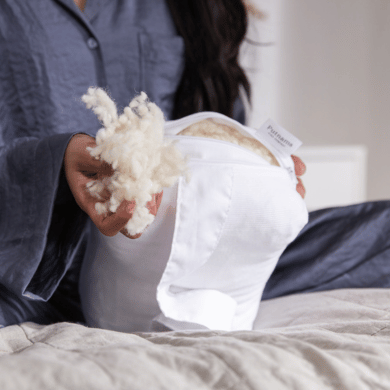
A supportive pillow such as the Putnam Pillow helps maintain spinal alignment overnight, giving your body the rest it needs to fully recover from the physical demands of travel.
Addressing postural biomechanics during your journey and prioritising decompression on arrival won't just eliminate travel stiffness, it protects your long-term spinal health, so every trip leaves you feeling capable and ready to explore rather than counting down the hours until you can lie down. Take a moment and review the complete Putnams Travel range that will make your next journey just that little bit easier.
Frequently Asked Questions
Why does my body hurt after a long flight even if I didn't exert myself?
Sitting still for hours increases spinal disc pressure, restricts circulation through inactive calf muscles, and exposes your body to dehydrating cabin air. These combined effects explain body aches after flying, even without physical exertion.
How can I avoid stiffness on a long car journey?
Adjust your seat so your knees sit level with your hips, use lumbar support to preserve your spine's natural curve, and stop every 90-120 minutes for a short walk. Seated ankle pumps and pelvic tilts during driving also help maintain circulation.
Is travel stiffness a sign of something more serious?
Mild stiffness that eases with movement is a normal response to prolonged sitting. However, persistent pain, numbness, or discomfort that worsens over several days may warrant a check-up with a healthcare professional.
What's the best way to recover from travel aches once I'm home?
Prioritise gentle decompression, such as lying with your legs up a wall, followed by dynamic stretching and rehydration. Supportive sleep positioning afterwards helps your body complete its recovery.
Do travel pillows and cushions actually make a difference?
Yes. Ergonomic research shows that maintaining the spine's natural lumbar curve during long periods of sitting can reduce intradiscal pressure by up to 40%, which is why supportive cushions and contoured neck pillows are worth packing for any long journey.


From the blog
View all



Leave a comment